
How do 4G mobile routers compare to 5G options for business applications?
Understand the difference between 4G and 5G mobile routers for business. See how the tp link tl mr6400 performs in a work environment. Make the right choice for your business connectivity needs.
Choosing between 4G and 5G mobile routers for business applications largely comes down to balancing speed, reliability, coverage, and cost. 4G mobile routers are mature, widely supported and generally sufficient for many small and medium-sized enterprises that need dependable connectivity for cloud applications, VoIP calls, email, and standard business software. Devices such as the TP-Link TL-MR6400, for example, can provide stable 4G LTE connectivity, integrated Wi-Fi, and straightforward deployment, making them suitable for offices, temporary sites, and backup connections. For many organisations, 4G performance is more than adequate for day-to-day operations, especially where ultra-low latency and extremely high bandwidth are not critical requirements.
5G mobile routers, by contrast, are designed to deliver significantly higher speeds, lower latency and better performance in high-density environments. This makes them attractive for data-intensive tasks such as large file transfers, real-time collaboration with high-definition video, and applications that rely on rapid response times. However, 5G coverage is still developing in many areas, and equipment and tariffs can be more expensive. For businesses across the Midlands, a practical approach is to evaluate the availability of strong 5G coverage at their locations and consider whether their applications genuinely require the additional performance. In many cases, a robust 4G router such as the TP-Link TL-MR6400 will be adequate, with 5G considered for future-proofing or specific high-demand use cases.
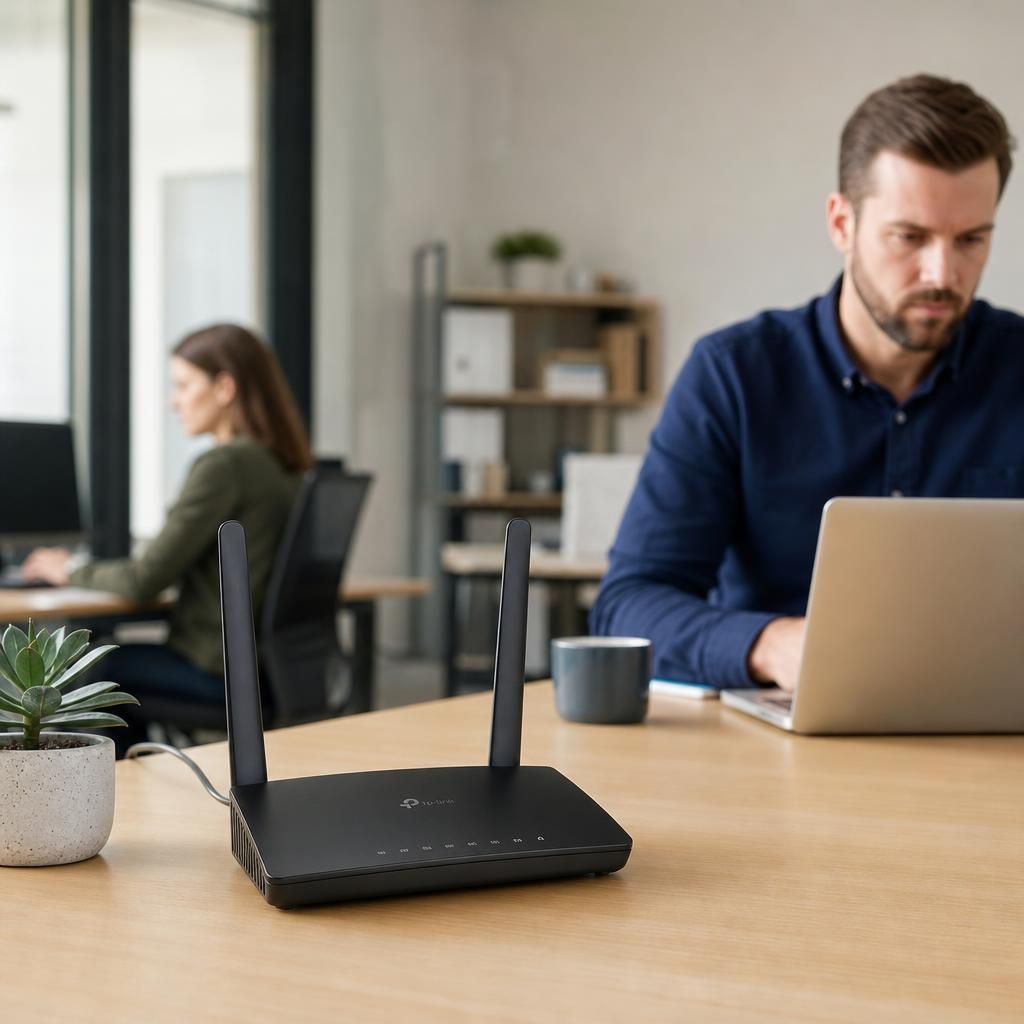
From a performance perspective, 5G routers can deliver multi-gigabit speeds and much lower latency than 4G, which benefits bandwidth-heavy workloads and time-sensitive applications. However, for typical SME usage – cloud CRM, hosted telephony, web-based tools and remote access – 4G speeds are usually sufficient, provided the signal is strong and the router is correctly sited and configured.
Coverage and reliability often favour 4G at present, as 4G networks are more established and widespread, including in semi-rural and industrial locations. A 4G router such as the TP-Link TL-MR6400 can therefore provide more consistent service across varied premises, especially when paired with suitable external antennas or used as a failover to fixed broadband.
Cost and practicality are also key considerations. 4G hardware and data plans are typically more affordable, and deployment is straightforward. 5G solutions may be justified where confirmed 5G coverage exists and the business has clear, measurable needs for higher throughput and lower latency.
Upgrade Your Business Connectivity Today
Discover the perfect router solution for your business needs. Whether it's 4G or 5G, our expert insights and product range ensure seamless connectivity and optimal performance in any environment.
Contact Us